
My best friend’s father went through open-heart surgery. He almost died. After weeks of recovery, he confided, “When that’s you, and you don’t have anybody to walk through the door and hold your hand, it’s demoralizing. But when you have family, friends, a small group, and church members texting, dropping off meals, praying for you…they are your armor.” Family and community are the living arms through which God expresses His love.
Care starts within the family. God designed relational connections and material provisions to be expressed within the relationships among spouses, parents, siblings, and grandparents. God’s tremendous compassion is to be portrayed through us to the people we know most intimately.
Love is an Action
Love is more than a feeling or emotional sentiment. If I feel something but do nothing to demonstrate love, I have not actually expressed love. Compare the similar comments between both Apostles James and John:
“If anyone has material possessions and sees a brother or sister in need but has no pity on them, how can the love of God be in that person? Dear children, let us not love with words or speech but with actions and in truth” (1 John 3:17–18).
“Suppose a brother or a sister is without clothes and daily food. If one of you says to them, ‘Go in peace; keep warm and well fed,’ but does nothing about their physical needs, what good is it? In the same way, faith by itself, if it is not accompanied by action, is dead…Show me your faith without deeds, and I will show you my faith by my deeds.” (James 2:15–17).
In our families, listening, affirmation, material provision, encouraging support, prayers, love, and concern are demonstrated through our actions.
Family’s First Responsibility
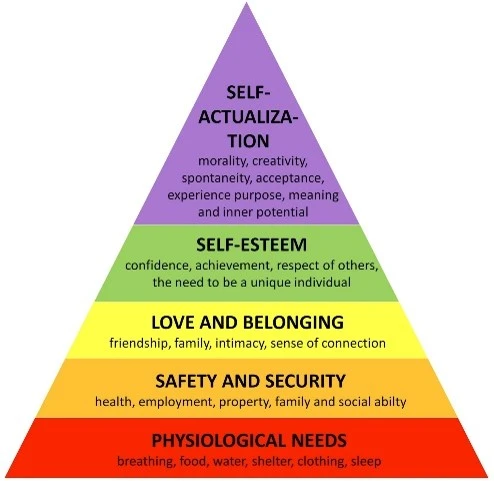
God ordained human relationships to emerge within a home-nest of committed love; husbands and wives committed to each other produce life (that’s the design anyway). That commitment guarantees they are taking the responsibility to care for the vulnerable children they produce. In 1943, psychologist Abraham Maslow proposed that people’s basic needs must be met first, then the emotional needs of friendship and belonging, and finally the needs of being supported in their personal agency and purpose. In other words, we feed the stomach, the soul, and the spirit—in that order. (You can see the graphic.) Families have the first responsibility to provide materially, emotionally, and spiritually for each other.
When a child grows to become a young adult and moves out of a house, that child assumes independence with personal boundaries. They form an independent family unit with their own unique responsibilities and boundaries. The broader family network may still share a responsibility to care for their extended family units, but the child assumes ownership for the life choices that are within their control. Social networks, such as the church or community, may step in if a broader family structure has exhausted its ability to care for a family member. And finally, after these relational networks are exhausted, the state intervenes where it must.
If our families and communities don’t know how to appropriately manage human needs, those needs can be neglected, on one hand, or used to manipulate people for handouts, on the other hand. It’s important that we think wisely about how to respond. Look at the Apostle Paul’s response to the crisis of widows in Ephesus:
Give proper recognition to those widows who are really in need. But if a widow has children or grandchildren, these should learn first of all to put their religion into practice by caring for their own family and so repaying their parents and grandparents, for this is pleasing to God. The widow who is really in need and left all alone puts her hope in God and continues night and day to pray and to ask God for help. But the widow who lives for pleasure is dead even while she lives. Give the people these instructions, so that no one may be open to blame. Anyone who does not provide for their relatives, and especially for their own household, has denied the faith and is worse than an unbeliever (1 Timothy 5:3–8).
The church materially supports the vulnerable widows, but on two conditions: first, that the family has done all it can, and second, that the widow is not taking advantage of the system.
Identified as Vulnerable
Don’t miss the obvious, that the widow is identified by the church as a vulnerable type of person worthy of consideration for support. Vulnerable people are incapable of fully providing for themselves. In ancient Israel, there were four classes of vulnerable people: the poor, the widow, the orphan, and the foreigner (Zechariah 7:10). Today, we might also include the handicapped or special needs person. Under God’s laws, Israel, then later the Church, was to assume the responsibility to look out for the vulnerable person within their community. God cares for the material needs of the vulnerable. In your family, that might mean taking care of your special needs child. It may involve a hands-on approach to your aging parent’s health care needs, or it may mean babysitting your grandkids during the day so that your single-parent daughter can earn an income.
Boundaries and Capabilities
Some families simply don’t have the capacity to care for their family members. That’s how the list of widows came to be in the first place. Death, disease, or geography may push care beyond the ability of a family. Family members may not live in the same area as their parents, or they may not have the financial resources to pay for a health care provider. It could be that their house is too small to take in an extra family member. Families should not feel guilty for care they are incapable of providing. In such a case, they might offer emotional support or prayer, or consider a supplemental financial gift within their means.
Care Without Dysfunction
While some families may not have the means to support their vulnerable members, other family members don’t have the integrity to warrant support. Some family members are simply dysfunctional or toxic; they are not emotionally or spiritually healthy people, and the broader family has the right to maintain personal boundaries. Family members and churches should not feel obligated to compensate for the poor choices of their relative. This requires discernment. Too often, people have taken advantage of family members who show kindness. An addicted daughter manipulates her mom’s sympathy to get bailed out of a situation. An elderly dad lays on the guilt trip to his children for not responding exactly the way he expects them to. Or an adult brother attempts to coerce his younger brother into loaning money, even though he’ll probably spend it on gambling. There may be creative ways to ensure that the person gets bread and shelter to survive. But beyond that, family members don’t need to feel guilted into saving that person from a catastrophe of their own making.
Three times Paul qualifies that the church should give only to widows who are “really in need” (v. 3, 5, 16). The core principle is that discernment is the appropriate first step before financial handouts. In verses 9–16 of that same section, Paul severely chastises younger widows who are abusing the system and not contributing to the community in productive ways. Families and church communities have the right to discern how they use their limited resources to help people. We want to invest our resources into meritorious needs that alleviate suffering. And secondly, we do not want to enable dysfunction by compensating for unhealthy choices and shielding a person from the painful lesson they need to learn.
Care
God cares about broken people. And he is a God of fourth and fifth chances. Mercy and care are discerned and expressed in our families first. Material, relational, and spiritual support start in the home. And financial generosity is connected to wisdom and discernment. “When you have family, friends, a small group, and church members texting, dropping off meals, praying for you…they are your armor.”
Additional Resources:
Taking Care of My Aging Parents
God’s Extraordinary Care
Special Needs At Petra Church




Login To Leave Comment